

TL;DR
- If you only look at your own rankings, you’ll miss what your competitors are doing better.
- SEO competitive analysis reveals content gaps, keyword opportunities, and backlink opportunities.
- We’ll show you the tools and steps to gain real insights in just one morning.
- The benefit: a targeted SEO advantage instead of a six-week project.
In a nutshell:
- If you only focus on your own rankings when it comes to SEO, you’ll miss what your competitors have been doing better for a long time.
- A thorough SEO competitive analysis reveals content gaps, keyword opportunities, and backlink potential—without turning it into a six-week project.
- We’ll show you the tools and steps that deliver real insights in just one morning.
No matter what niche you’re in, competition is everywhere. And to gain an edge over competitors, it’s worth conducting an SEO competitive analysis. But a competitive analysis isn’t just essential for keyword research—it’s also vital for gathering ideas.
But how do you find your competitors, and what’s the best way to analyze SEO performance or Google rankings? That’s exactly what you’ll learn in this article.
How do we find our competitors?
If you already know who your competitors are because they’re in the same city or even on the same street, this question might be easy to answer. But in many industries, competitors aren’t necessarily right across the street—they might be on another continent. If that’s the case, you’ll need to use other methods to track down the competition.
So, how do you find your competitors?
Direct or indirect competitors?
First, you should distinguish between direct and indirect competitors. Direct competitors are in direct competition with you. This means they operate in the same niche and therefore offer the same services or products. Indirect competitors are also in the same niche or industry, but their topics or products are more diverse. Although indirect competitors are also rivals, they only compete with you indirectly, since they are active in other subject areas as well.
Create a competitor list using an SEO tool
Compile a list of at least ten websites that operate in the same niche. Especially if you want to analyze competitors for many keywords, you can use online SEO tools like Sistrix to help you. With Sistrix, you can enter the URL of your own website or that of a competitor, and competitor websites will be displayed. You can test Sistrix for free.
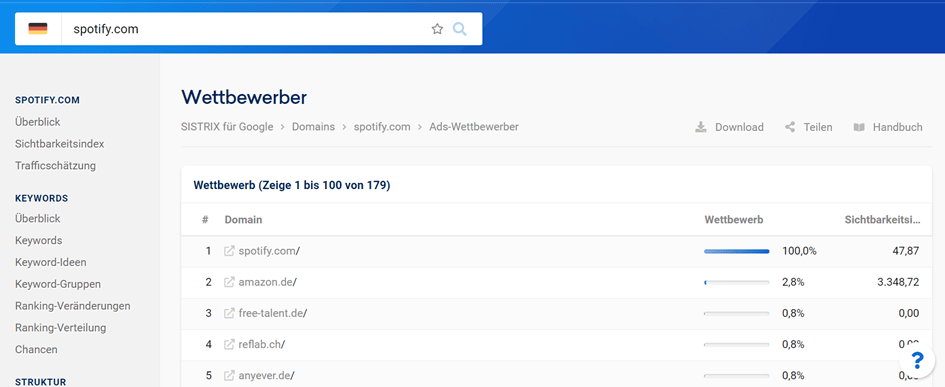
Image: To find competitors for a specific domain, enter it in the search bar. Then, in the left sidebar under the “Ads” tab, select the “Competitors” category. In this case, we analyzed the domain “spotify.com,” which shows competitors such as “amazon.de” and “free-talent.de.”
Create a competitor list manually
Of course, you can also do this manually by Googling relevant keywords and reviewing the search results. This gives you an overview of which domains rank ahead of you. From there, you can also take a look at the individual websites to examine and evaluate them more closely.
Here are a few questions you should ask yourself during the competitor analysis: For which keywords does our website rank? Which websites appear particularly frequently in the top 10 for specific keywords? Are there competitors that often appear in the top 5 for various keywords?
It’s best to look at several websites for different keywords so you can determine whether they are direct or indirect competitors.
Analysis
After you’ve created a list and done some research on your competitors’ websites, you can analyze their performance. With tools like SimilarWeb or Sistrix, you can get an overview of which websites are the most successful by looking at their monthly traffic statistics.
Why conduct a competitive analysis?
But why is a competitive analysis important in the first place? While an SEO-optimized website is a must, the work doesn’t end there. To stay at the top of search results, you need to stay on top of things. But if you don’t know what your competitors are doing, it’s difficult to outrank them in search results.
Before you conduct a competitive analysis, you should therefore be clear about your goals. Think about whether you want to, for example, increase traffic to your website, improve your search engine ranking, or differentiate yourself from competitors. This will help you save time and use analysis tools effectively.
Steps for SEO Competitor Analysis
Once you’ve identified which competitors are relevant to you, you can analyze factors such as their on-page and off-page optimization, social media presence, or organic traffic. You can find out which other factors are important here.
Depending on where your business currently stands, you should examine different aspects in your competitive analysis. When starting a business or a website, a competitor analysis can be helpful in generating new ideas. If you’re already established, a competitor analysis can provide new insights. It’s best to review your competitors once a year to stay up to date.
Keywords
SEO tools like Sistrix help you find your competitors’ keywords. You can enter your competitors’ domain in the search bar to find out which keywords they rank for. This can also give you inspiration for your own content.
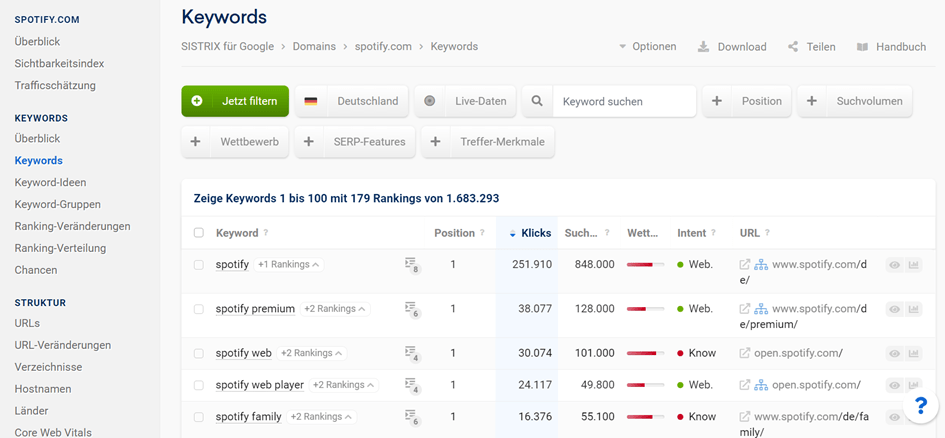
Image: According to Sistrix, “spotify.com” ranks for these keywords.
Identify the competition’s strengths and weaknesses
An important part of competitive analysis is identifying your competitors’ weaknesses. For example, it can be worthwhile to look at new and lost keywords. While new keywords indicate that the competitor is tapping into or wants to tap into a new niche, lost keywords show whether your competitor has been penalized by search engines and has consequently lost rankings. This also presents an opportunity to take over the competitor’s former rankings.
Tools like Semrush or Sistrix help you analyze competitors’ keywords.
Identify competitor keywords
When conducting a competitive analysis, you should also pay attention to differences in keyword coverage. Using filters in your preferred SEO tool, you can, for example, view keywords where only your competitor ranks. This reveals opportunities to incorporate those keywords into your own content creation.
You can also use advanced filters to find keywords where your competitors rank low. You can then optimize your own website content so that it ranks better for these keywords than your competitor. For example, if your competitor appears on the second page of search results, you should aim to outrank them.
In addition, you should also conduct keyword research on shared keywords. You can find these using SEO tools like Sistrix or Semrush. To continuously track keyword rankings, you can export keyword lists as CSV or XLS files.
Content
The content of competitor websites is particularly important. Ask yourself the following: Are the texts well-written for important niche keywords? Is the content targeted and informative? What questions do the texts answer?
To outrank your competitors, you should create better and more informative content. Here are a few more factors to consider in your competitor analysis:
- Do the texts address users’ search intent?
- Do competitors offer freebies (such as e-books or videos) related to specific content?
- Are there article series?
- How long are the texts?
- Is the content presented with infographics?
- Are the texts updated regularly?
Compare your website content with that of competitors, paying attention to differences and similarities. This will help you determine whether your competitors are successful because they offer good content.
The number of views for a competitor’s website says little about the quality of the content. Although some websites attract many visitors, that doesn’t mean the content offers added value. So keep a critical eye during your competitor analysis.
Regular content analysis is a crucial step in SEO competitor analysis. After all, the better a website’s content, the higher its ranking. Content analysis also helps you generate ideas for your own website.
SEO
Of course, SEO is also an important topic in your competitive analysis. In the following section, you’ll find out what to look for in your competitive analysis.
Web Design and UX Design
What target audience do your competitors appeal to? What trust signals are being sent? Is the design up-to-date and tailored to the target audience? Questions like these are important when analyzing web design and UX design.
You can identify the target audience, for example, by the font. A playful font may indicate that younger people are being targeted, while a conservative font tends to appeal to older people.
You can also draw inspiration for your own website from the web design analysis. The better the user experience, the happier your visitors will be and the better your Google ranking will be.
Page Speed
A website’s loading speed is one of the most important SEO parameters. So pay attention to how quickly your competitors’ websites load. With online tools like Pingdom or pagespeed.web.dev, you can check and compare the loading times of any website.
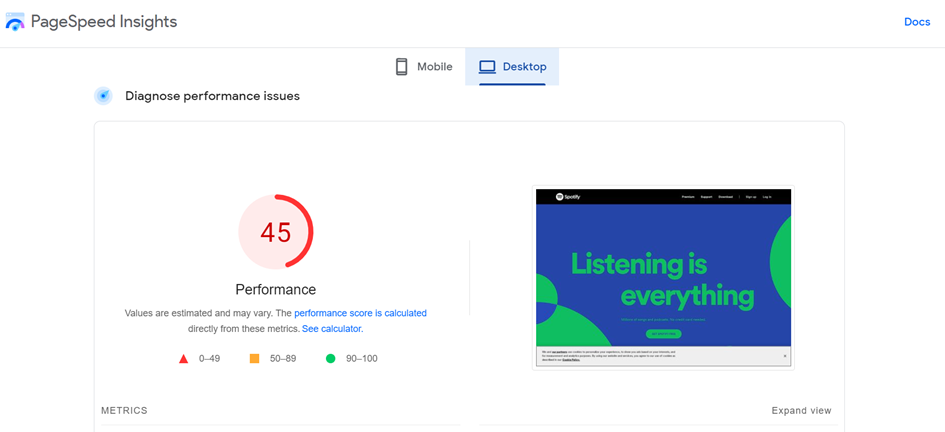
Image: Here you can see how spotify.com performs in terms of loading speed.
Compare your website’s loading times with those of your competitors. If your site loads significantly slower, you should work on improving its loading times.
Site Architecture
Site architecture is also an important aspect of competitive analysis. Ask yourself the following questions: How are the menu items structured, and which keywords are used? Are there menu subcategories? Does your competitor offer a blog or news section? Is there an About Us or Contact page?
Internal linking also plays a major role in site architecture. To assess this, you should examine how your competitor links to internal pages. These links are often found within body text. Also pay attention to the anchor text your competitor uses for these links. Internal links reveal a lot about which keywords a website has been optimized for.
Outbound (external) links show you which websites your competitors link to. External links are only an indirect ranking factor, as they help build trust with visitors and search engines.
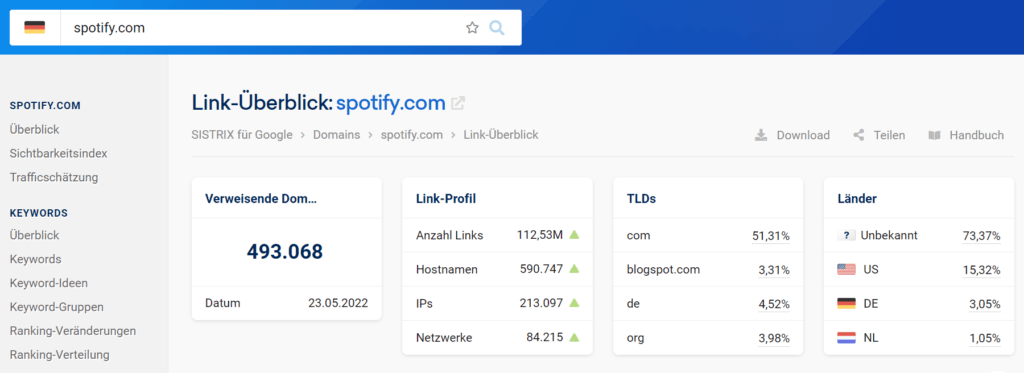
Image: Sistrix gives you an overview of links for any domain.
Domain Age
Older domains that are more than three years old often rank better on search engines like Google because they have built up greater trust over time. If many of your competitors have older domains, it can be difficult to achieve good rankings quickly, especially if your website is relatively new.
Domain Authority/Page Authority
Using SEO tools like Moz or Ahrefs, you can check metrics such as Domain Authority and Page Authority. These two values are used to evaluate domains based on their strength. The higher they are, the better. If the DA and PA values are above 30, you can assume the website is well-optimized. If they’re over 50, you’re up against a strong competitor.
While these metrics are useful for competitive analysis, you shouldn’t rely on them entirely. For example, high-traffic websites like Amazon may have high DA and PA scores, yet you can still outrank their poorly optimized subpages in search engine rankings. So, with significantly better content than competitors in your niche, it’s also possible to outrank them.
Visibility Index and History
SEO tools like Sistrix or Semrush help you analyze your competitors’ rankings. In addition to the ranking, however, factors such as the visibility index and the current visibility score are also important.
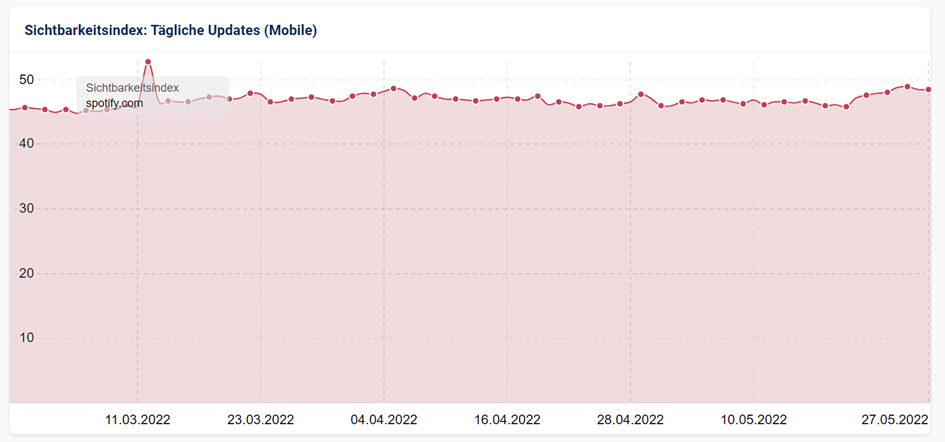
Image: The current visibility index for spotify.com looks like this on Sistrix, for example.
The trend of the visibility index can be positive or negative. A negative index, for example, indicates that the website is losing trust or that SEO measures are being neglected. However, this does not necessarily mean that the site is easy to overtake in the rankings. Fluctuations in the visibility trend, on the other hand, may be due to a search engine penalty.
Organic Traffic
Online tools like Semrush or Ahrefs help you analyze your competitors’ organic traffic. Although the data isn’t 100% accurate, it’s worth looking at competitors’ organic traffic. Pay attention to the keywords for which your competitors are receiving organic traffic.
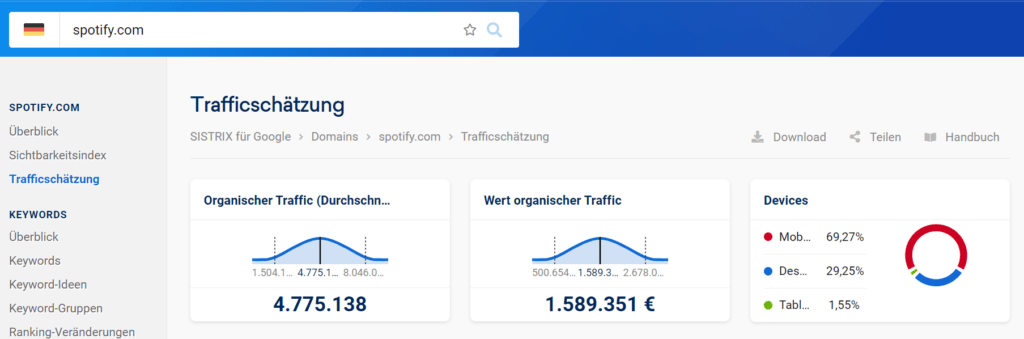
Image: Here’s an example of Spotify’s traffic estimate on Sistrix.
Additional Analysis Factors
Brand identity is also part of competitive analysis. This includes the logo, color palettes, and design, as well as the target audience your competitor aims to reach. There are several advantages to knowing your competitors’ brand identities, as this allows you to specifically differentiate your own website or brand.
Social Media
You don’t need any special tracking tools to analyze your competitors’ social media activity. Instead, simply follow your competitors on social media and view their profiles.
Ask yourself the following questions:
- How does the competitor present itself on Instagram or Facebook?
- What target audience are they addressing?
- Do they respond quickly to comments?
- Are the posts well-written?
- What would you do differently?
Price List
Competitors’ prices are also an important factor in competitive analysis. Are there any unique aspects to your competitors’ pricing? Also pay attention to whether your competitors openly communicate their prices or not.
Conclusion: SEO Competitive Analysis – How Do We Identify Our Competitors?
Now that you’ve read a bit about competitive analysis, there’s one thing you should definitely keep in mind: It’s always helpful to know your competitors. This is the only way you can develop a feel for the market and understand which competitors play which roles.
If you know what the competition is doing, you can react more easily and quickly. And best of all: You’ll discover how to improve your own website.