

In a nutshell:
- Google Ads has replaced expanded text ads with Responsive Search Ads—if you’re still using the old approach, you’re wasting your budget.
- We explain what has changed, how to migrate existing campaigns, and which optimizations for Responsive Ads are replacing previous best practices.
Find out what this means here
Back in March, when Google replaced Expanded Text Ads (ETAs) with Responsive Search Ads (RSAs) as the default ad type for search campaigns, everyone basically suspected that ETAs might be discontinued soon.
In fact, on August 31, Google announced that ETAs will no longer be offered as of June 30, 2022.
The response to this announcement has been mixed. Although no one is actually thrilled about this change, advertisers are reacting very differently—in some cases based on personal experience, in others based on familiarity—and are expressing various concerns.
To help you assess the situation, we’d like to provide some background on the individual points.
Find out more below:
- How and when Google is phasing out ETAS.
- What you should be concerned about (and what you shouldn’t).
- What you can do to keep your search strategy successful.
The facts about ETAs
On August 31, Google announced that starting June 30, 2022, Responsive Search Ads (RSAs) “will be the only search ad type that can be created or edited in standard search campaigns.”
What does this mean?
While existing Enhanced Text Ads (ETAs) will continue to run and you’ll receive reports on their performance, you’ll only be able to pause, resume, or remove them—but you won’t be able to create or edit new ones.
Why are ETAs being phased out?
Google’s position on this change is as follows:
- Given that 15% of search queries are new every day, automation is key to keeping pace with this trend.
- The RSA solution allows you to stand out among a wider range of relevant ads and generate additional revenue with fewer ads.
Reasons for concern regarding RSAs
As with most announcements from Google, the overall sentiment is positive.
However, let’s take a closer look at the background behind some of these concerns so you can assess the extent to which the change will—or won’t—impact your account.
Issues with ad copy
Many advertisers like ETAs because they give them more control over their ad copy, and the switch to RSAs makes some feel that Google is now taking full control.
But it’s really more about context and user experience.
“That’s true to a certain extent. “Google isn’t taking direct control of the text, but rather of the order of the text—which, of course, can completely change the context of the ad.
From our perspective, advertisers won’t miss the lack of control as much as they’ll miss the straightforward creation and implementation of text ads. Advertisers who struggle with three headlines and two descriptions will have a much harder time with 15 headlines and four descriptions.
With RSAs, the problem isn’t even necessarily the lack of control over the order. Sometimes there are simply too many ways to say, “Get your insurance with us” or “Call us to schedule a consultation.”
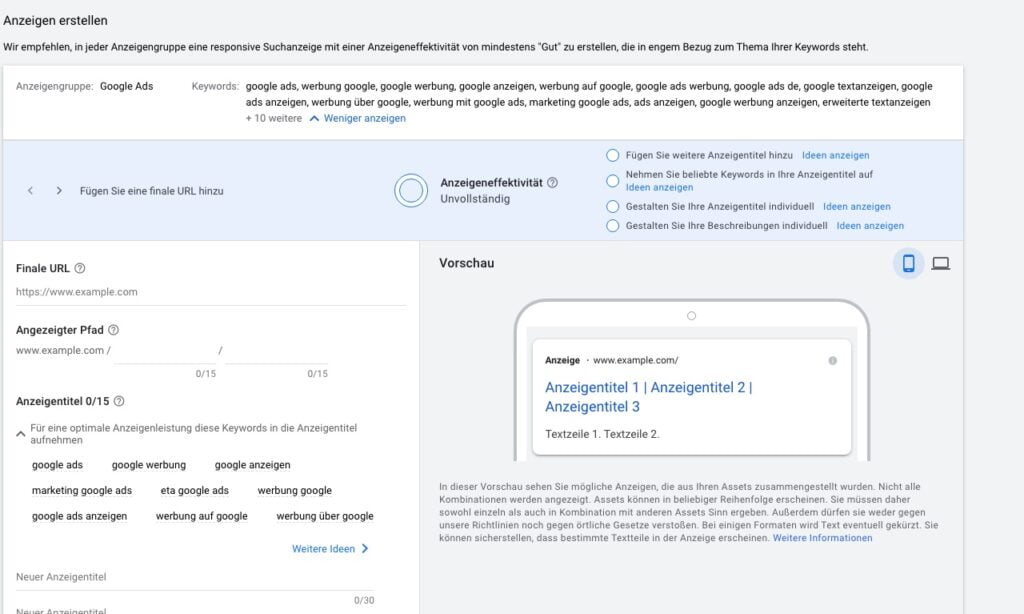
Workarounds for pinning have their limits
Another issue related to this change affects businesses in highly regulated industries such as the pharmaceutical industry, credit unions, franchises, and the legal sector. In a tweet by Pete Bowen, he notes: “In some states, you have to obtain (and pay for) approval from the bar association for every version of the ad.”
Workaround #1: Pin them all
You can create ETAs using pinning. Simply create three headlines and two descriptions in the RSA and pin them all.
Not really practical, because it undermines the purpose of RSAs. We wouldn’t be surprised if Google blocks the ability to use all pins in the future, but it might work
Workaround #2: Pin some, skip the rest
Another alternative is to fill out only three headlines and two descriptions and leave the rest of the RSA blank, just like an ETA. However, Google recognizes the quality of ads in these workaround scenarios, so the Quality Score or ad rank could potentially be affected.
On the other hand, the Quality Score has become of varying importance to advertisers.
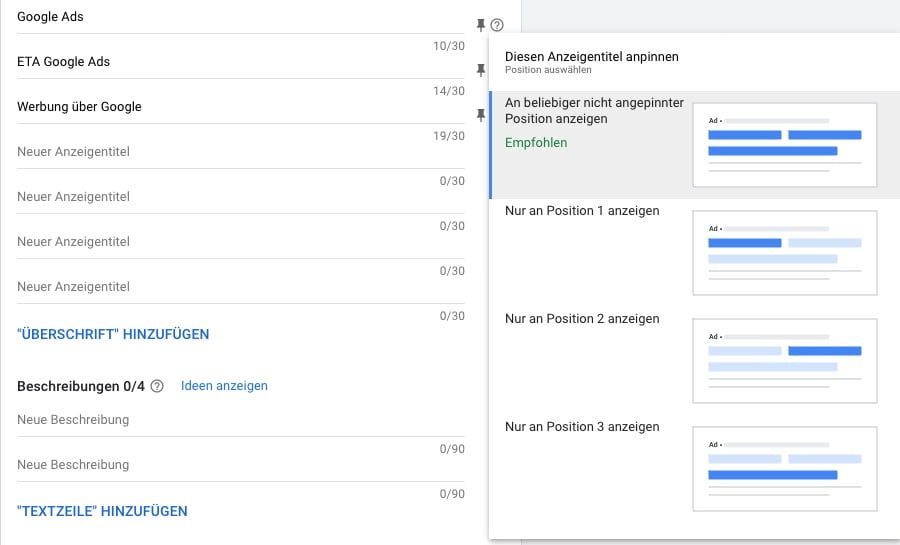
RSA reporting isn’t particularly good
Another problem advertisers face is reporting. Reports allow you to test or optimize, and the whole point of RSAs is to incorporate testing into the campaign and let Google handle this task. The idea is that you save time on Google Ads while Google delivers more relevant headlines to searchers.
Chris Ridley tweeted on this: “Ad text optimization cannot be based solely on which combination Google prefers in practice.”
This argument is certainly valid. However, some advertisers are demanding the ability to generate a report for every version of the ad.
Has reporting been improved? Maybe. Detailed? Possibly too much.
While there is reporting for RSAs, and it is quite helpful, it is VERY detailed reporting. With 15 headlines and four product descriptions, there are thousands of combinations. Even if the industry wants detailed reporting on each of these categories, no one in their right mind would actually go through it all. Maybe for top performers, but that could still change.
The information Google provides for reporting on RSA combinations is great, and we use it constantly.
Make it usable!
It would be nice if the RSA data were actionable or professional rather than a generic “Best” or “Good,” and it would help to know which combinations work well together.
Reasons not to panic about the phase-out of ETAs
For most advertisers, this development came as no surprise. We could already sense it coming when Google announced in March 2021 that it would make RSAs the default ad type for search campaigns, and then tried to make it harder for users to access the ETA creation portal.
On LinkedIn, Navah Hopkins echoes this sentiment: “Am I surprised? Not at all—ETAs have been hidden for new ad accounts for some time now, and they almost always lose out to RSAs in terms of impressions.”
Well, you may not be surprised, but you’re still feeling uncertain.
Here are some helpful tips and suggestions.
1. Automation is getting better and better
Many fear that this is just another step in Google’s push toward automation, but consider these perspectives.
Automation isn’t inherently bad
In the LinkedIn post mentioned above, Navah Hopkins writes:
“Am I worried? Not really! Google Ads has done a really good job of improving the ad format, allowing us to simulate the brand integrity of ETAs while benefiting from built-in A/B testing.”
RSAs are often more effective than ETAs
In our experience, we’ve often found that RSAs perform better than ETAs. Not always, but generally speaking. Perhaps this is because Google secretly favors them and ranks them higher. We don’t know. But it certainly fits with Google’s general drive toward automation and its faith in its algorithms. Admittedly, Google has made progress in the field of machine learning over the years (which is probably why they’ve decided to take this step now). But they still have a long way to go.
But not always
Unfortunately, not all advertisers have had such positive experiences.
Carolyn Lyden of Search Engine Land takes a different view in her report on this topic:
- “In my experience, RSAs almost always perform worse than ETAs,” says Collin Slattery, founder of Taikun Digital.
- “RSAs almost always perform worse than ETAs, despite millions in spending and years of testing. It’s not even close,” agreed Sam Tomlinson of EVP Warschawski.
But they’re here to stay
Either way, automation is the inevitable future of the advertising industry, even if we’re reluctant to admit it.
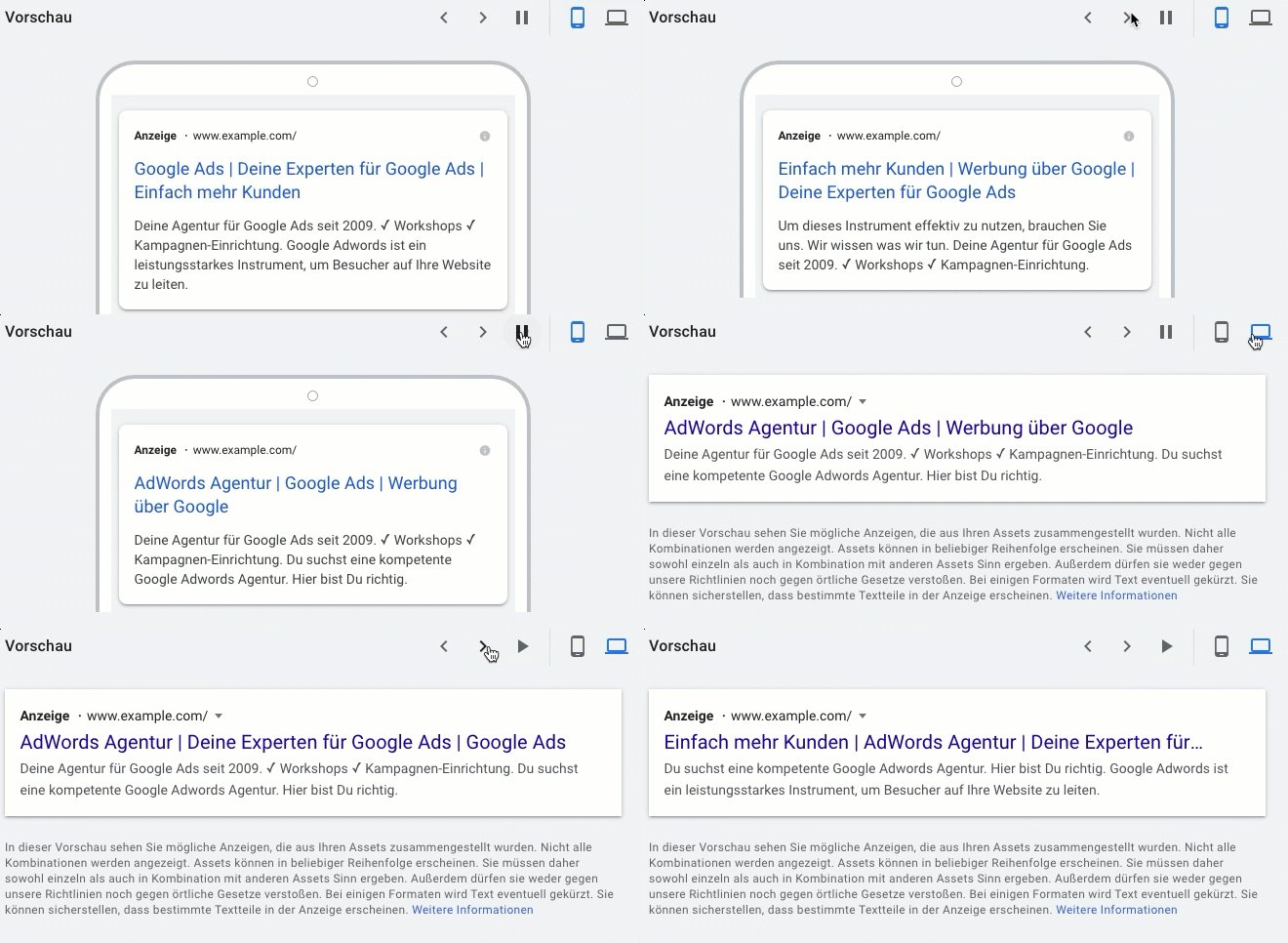
2. ETAs aren’t just on Google Ads
We mustn’t forget that there’s another platform that offers ETAs.
What was its name again?
That’s right, Microsoft Advertising. Microsoft Ads has established itself as an excellent alternative to Google for those who want to retain control over their advertising.
It’s kind of like asking your mom for something, and she says no, so you go to your dad. “There are plenty of fish in the advertising sea”
Microsoft also offers Enhanced Text Ads, and in fact, we’ve found that Microsoft’s ETAs actually outperform Google’s.
3. You still have some control
As mentioned earlier, pinning still gives you some control.
Just don’t pin excessively!
Pinning really seems to be our savior here. But remember that Google will downgrade your ad quality if you pin too much. There’s even a small note about how excessive pinning isn’t recommended.
Still, pinning is the best tool we have to maintain control. But if everyone starts overusing this feature, it will likely be removed again soon—that much is clear.
4. Ad Customizers (and DKI) are here to stay
Many advertisers will wonder if ad customization is also being discontinued. However, you may have missed the fact that ad customization has always been available for RSAs (though not globally) as well as for Dynamic Keyword Insertion.
5. We still have time
In this context, ZATO owner and PPC expert Kirk Williams praises Google for the “longest advance notice we’ve ever received for a major change to Google Ads.”
And digital marketing expert Steve Plimmer points out in a tweet that Google will hopefully provide us with useful information over the next 10 months.
So what should you do? Tips for ETAs and RSAs
As mentioned earlier, we still have time. Below are our recommendations.
1. Create and test ETAs
Take a deep breath, and remember that your ETAs won’t be changed and will continue to run. So put your ETAs through their paces until then and keep the best ones running for as long as possible.
But don’t worry too much about ETA copy
Anyone who wastes their time these days fiddling with ETA ad copy has their PPC priorities in the wrong place.
Besides, there are so many other aspects you can control, such as audience management and much more.
In my opinion, PPC is often overcomplicated in an attempt to achieve the desired results, which simply don’t materialize—something we can certainly understand, since you’re spending your money on it. But honestly, changing the headline in your ETA won’t make your project a success.
Develop evergreen ETAs
Amy Bishop offers similar advice in her report in Search Engine Journal:
“I would definitely recommend testing ETAs extensively over the next few months, while you can still create them. Be sure to add a set of evergreen ETAs that you can continue to use in the future. You should even set up a few extra ads so you can continue testing even after you can no longer add new ETAs.”
2. Get familiar with RSAs
There are numerous tips and strategies for RSAs, but here are the most important ones:
- Update your ad text regularly so visitors always see something new.
- Use dynamic keyword insertion and ad extensions.
- Use the mixed preview images offered by Google.
- Make sure all combinations are compatible with each other.
- Use pinning.
- Use the ad optimization tool
3. Don’t forget call ads
Let’s remember that call ads are another option for search engine campaigns.
For many industries—such as law, medicine, food, and small businesses—call ads are a popular choice. And once set up, they stay active. So if you don’t want to use RSAs, ETAs, or anything dynamic, we’d definitely recommend these.
PLUS! Google recently updated these, so now you get an additional headline in addition to the number, company name, and two descriptions.
Accept, make adjustments, and wait
Acceptance: Regardless of how much this will impact your Google Ads performance, we can’t change Google’s decision, so acceptance is the best way forward.
Adapt: Learn about RSAs if you haven’t already, start creating ETAs, and take advantage of pinning features and call-only ads.
Wait and see: Hopefully, Google Ads will introduce some new features to help with reporting and other issues, so stay up to date on new announcements and platform updates.